Rediscovery · Extinction · Conservation
Rediscovering Quercus tardifolia
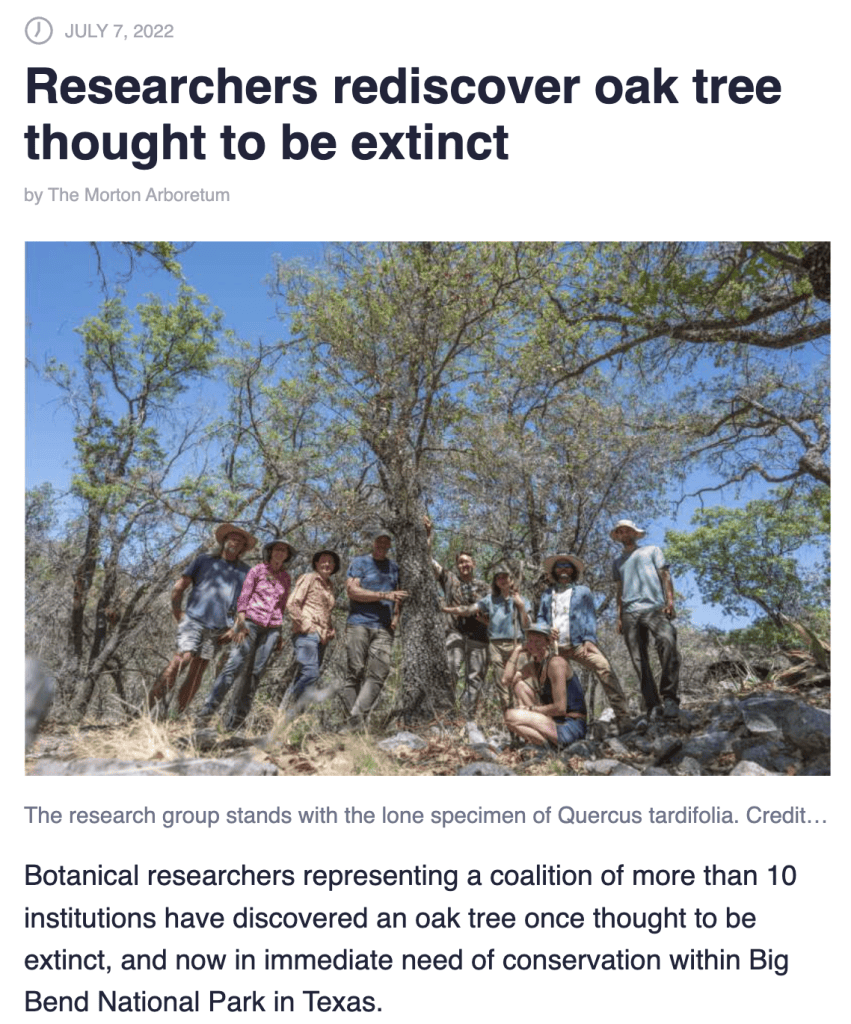
In May 2022, a collaborative expedition in Big Bend National Park found a living lateleaf oak after the species had been feared extinct. Finding the tree was only the beginning. The discovery created an immediate obligation to understand what it is, why it is disappearing, and how to keep it from vanishing.
Why it matters
Quercus tardifolia is an exceptionally rare oak associated with the Chisos Mountains of West Texas. The last known living specimen was believed to have died in 2011. When our team encountered a roughly 30-foot tree in 2022, it was alive but in poor condition, scarred by fire and showing signs of fungal infection. A single drought, fire, or other disturbance could have erased what might have been the species’ last known foothold.
Nature rarely hands us a second chance, and I doubt we’ll get a third. We won’t waste it.
The search
The expedition brought together researchers from more than ten institutions and was led by The Morton Arboretum and the United States Botanic Garden. I participated while serving as Chief Botanist at NatureServe. The team searched the rugged Chisos Mountains for rare oaks and, on May 25, 2022, located the tree that renewed the possibility that Q. tardifolia persisted.
What we needed to learn
Rediscovery did not settle the science. Oaks hybridize readily, and the taxonomic identity of lateleaf oak has long raised questions. Molecular work was therefore essential to compare the rediscovered material with historical Q. tardifolia and related red oaks. The conservation problem and the taxonomic problem were inseparable: before deciding how best to safeguard a lineage, we needed to understand its genetic distinctiveness and relationships.
From rediscovery to recovery
The immediate work shifted from searching to conservation: reducing threats, looking for reproductive material, attempting propagation, and building the genetic evidence needed to guide future action. For me, the lesson is larger than a single oak. Rediscovery is meaningful only when it creates a pathway to recovery. Finding a species gives conservation another opportunity to act before documentation becomes an obituary.


Leave a Reply