Assessment · Data · Conservation Priorities
U.S. Tree Assessment
Conservation action begins with a deceptively simple set of questions: What species are here? Where do they occur? And which are most at risk? This collaboration created a standardized checklist of native U.S. trees and a common conservation framework for answering them.
Why it matters
The contiguous United States supports nearly 900 native tree species. Yet conservation efforts had been limited by inconsistencies in the underlying information: which plants qualify as trees, which species are native, where they occur, and how threatened they are. Without a shared baseline, it is difficult to coordinate priorities across agencies, gardens, conservation organizations, and researchers.
Building a common foundation
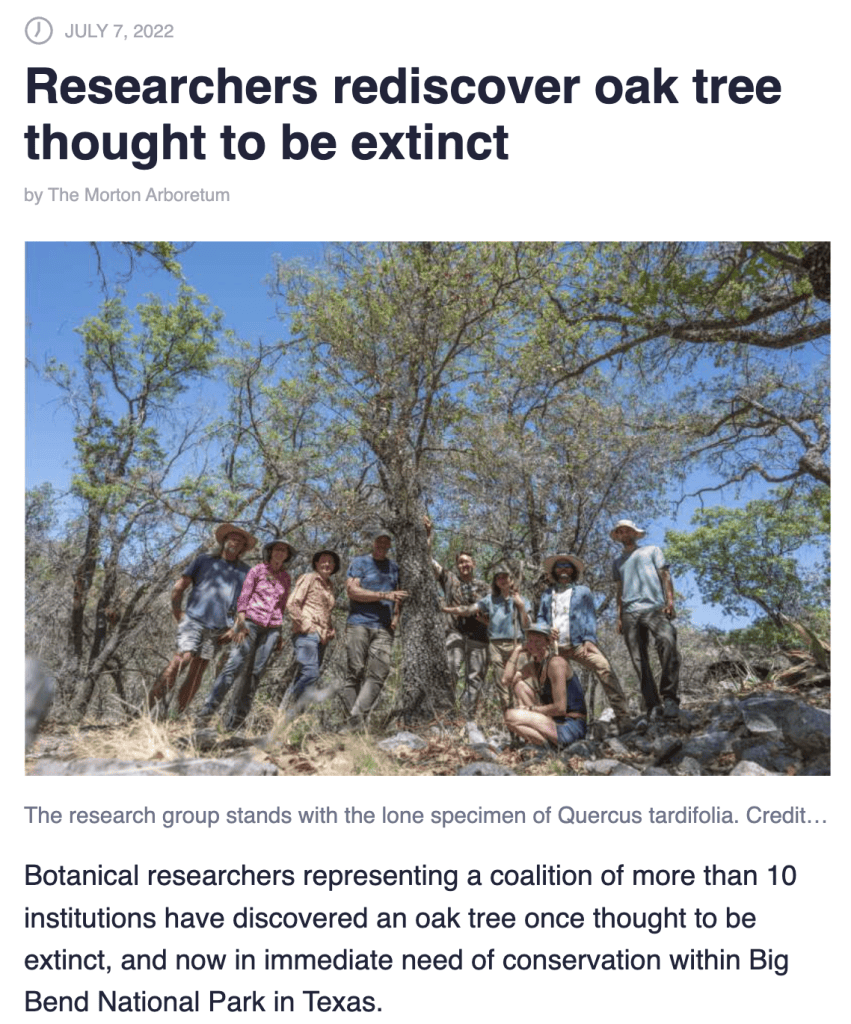
Our collaboration assembled a standardized checklist, mapped distributions, and brought conservation-status information together in a form that could be shared and acted upon. The work was led by a broad partnership that included The Morton Arboretum, the United States Botanic Garden, NatureServe, Botanic Gardens Conservation International, the U.S. Forest Service, and others.
From data to priorities
The value of a national assessment is not simply the list itself. Standardized information makes it possible to identify gaps, compare risk, coordinate collections and recovery work, and direct limited conservation capacity toward the trees that need it most. That connection between authoritative biodiversity data and practical action has remained a central theme of my work.
The publication
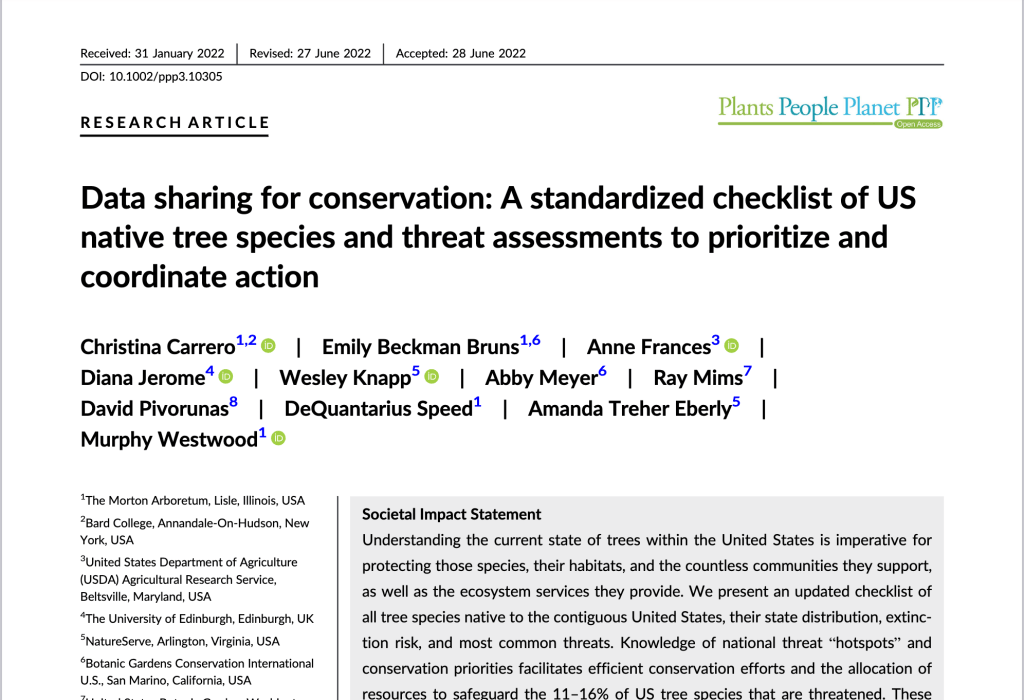
Carrero, C., E. Beckman Bruns, A.L. Frances, D. Jerome, W. Knapp, A. Meyer, R. Mims, D. Pivorunas, D. Speed, A. Treher Eberly & M. Westwood. 2022. Data sharing for conservation: A standardized checklist of US native tree species and threat assessments to prioritize and coordinate action. Plants, People, Planet.