Category: Uncategorized

  • Rediscovering Quercus tardifolia

    Rediscovery · Extinction · Conservation

    Rediscovering Quercus tardifolia

    In May 2022, a collaborative expedition in Big Bend National Park found a living lateleaf oak after the species had been feared extinct. Finding the tree was only the beginning. The discovery created an immediate obligation to understand what it is, why it is disappearing, and how to keep it from vanishing.
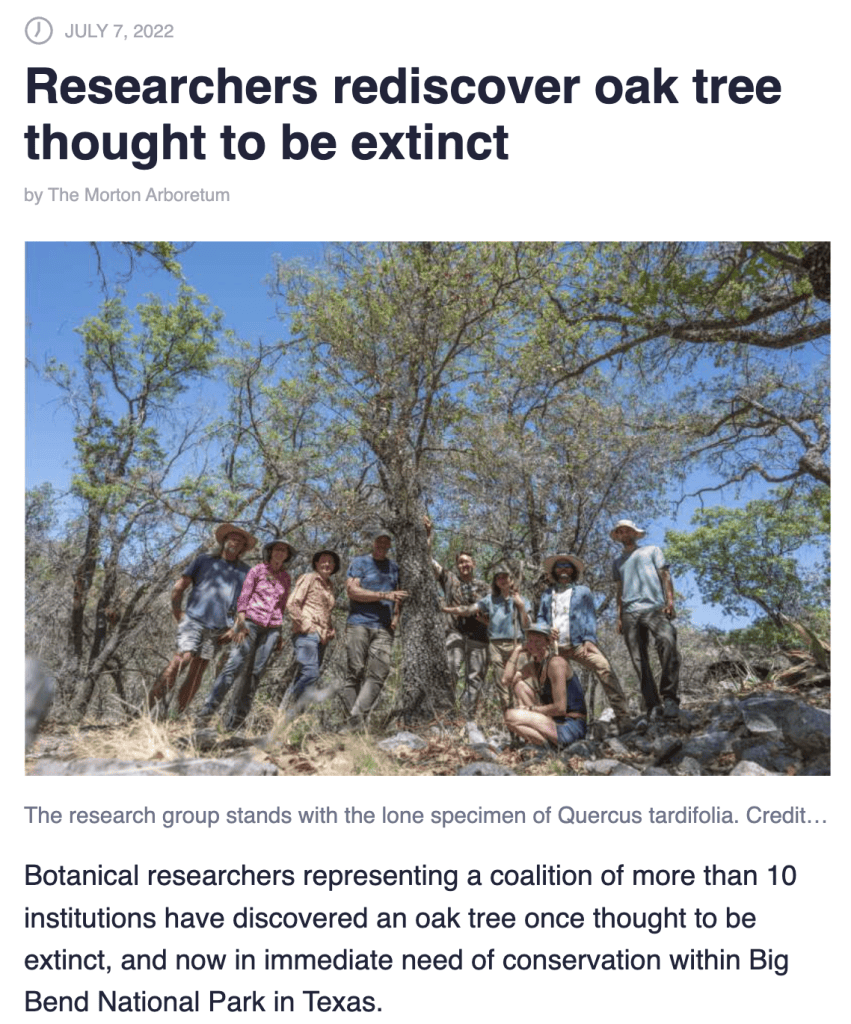
    Field team gathered around a rediscovered Quercus tardifolia in Big Bend National Park

    Why it matters

    Quercus tardifolia is an exceptionally rare oak associated with the Chisos Mountains of West Texas. The last known living specimen was believed to have died in 2011. When our team encountered a roughly 30-foot tree in 2022, it was alive but in poor condition, scarred by fire and showing signs of fungal infection. A single drought, fire, or other disturbance could have erased what might have been the species’ last known foothold.

    Nature rarely hands us a second chance, and I doubt we’ll get a third. We won’t waste it.

    The search

    The expedition brought together researchers from more than ten institutions and was led by The Morton Arboretum and the United States Botanic Garden. I participated while serving as Chief Botanist at NatureServe. The team searched the rugged Chisos Mountains for rare oaks and, on May 25, 2022, located the tree that renewed the possibility that Q. tardifolia persisted.

    What we needed to learn

    Rediscovery did not settle the science. Oaks hybridize readily, and the taxonomic identity of lateleaf oak has long raised questions. Molecular work was therefore essential to compare the rediscovered material with historical Q. tardifolia and related red oaks. The conservation problem and the taxonomic problem were inseparable: before deciding how best to safeguard a lineage, we needed to understand its genetic distinctiveness and relationships.

    From rediscovery to recovery

    The immediate work shifted from searching to conservation: reducing threats, looking for reproductive material, attempting propagation, and building the genetic evidence needed to guide future action. For me, the lesson is larger than a single oak. Rediscovery is meaningful only when it creates a pathway to recovery. Finding a species gives conservation another opportunity to act before documentation becomes an obituary.
  • Conservation Status of Trillium in North America

    Conservation Status of Trillium in North America

    Assessment · Native Plants · Conservation

    Conservation Status of Trillium in North America

    Trilliums are among North America’s most recognizable native wildflowers. Their familiarity can obscure an important conservation reality: species with restricted ranges, slow life histories, and specialized habitats can be vulnerable to pressures that operate across entire landscapes.

    A continent-wide assessment

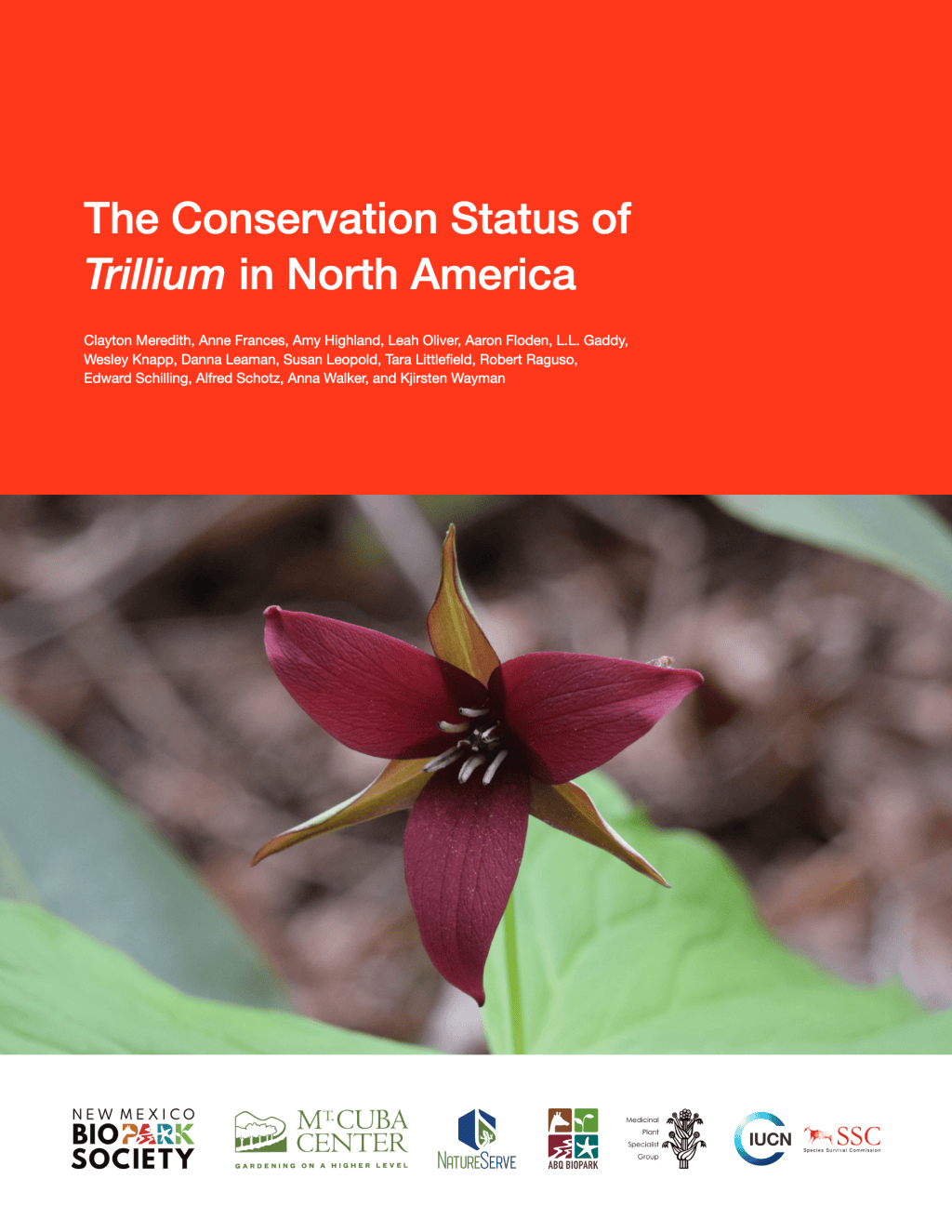
    Working with colleagues across the continent, I helped assess the conservation status of 53 Trillium taxa using both NatureServe and IUCN methodologies. The goal was not simply to assign ranks. It was to create a consistent picture of which trilliums are secure, which are declining, what is driving those declines, and where conservation attention is most urgently needed.

    What threatens trilliums?

    The assessment identified a suite of interacting pressures, including habitat loss and fragmentation, browsing by white-tailed deer, damage from feral pigs, invasive plants, harvest pressure, and other changes to forest ecosystems. These threats do not affect every species equally. Wide-ranging species may remain common overall while declining locally, while narrow endemics can be placed at risk by changes affecting only a small number of sites.

    Why assessment matters

    Good conservation begins with knowing what exists, where it occurs, and how it is doing. A rigorous assessment turns scattered botanical knowledge into priorities that agencies, land managers, botanical gardens, scientists, and conservation organizations can use. That progression from taxonomy and field knowledge to assessment and action has become a recurring theme throughout my career.

    From science to a broader audience

    The assessment also became an opportunity to bring plant conservation to people far beyond the scientific community. In 2022, Margaret Roach explored the conservation story of trilliums in The New York Times and subsequently invited me onto her A Way to Garden podcast to discuss rare plants, extinction, NatureServe, and why taking stock of native plant diversity matters.

    Listen to the A Way to Garden conversation →

    The work in context

    Trilliums are charismatic enough to attract attention, but the conservation problem they illustrate is much larger. Thousands of plant species receive far less public notice. Assessments like this provide the evidence needed to move from appreciation of biodiversity to deliberate action on its behalf.

    Explore more Conservation & Science →

  • From Field Botanist to Conservation Leadership

    From Field Botanist to Conservation Leadership

    Career · Perspective · Conservation

    From Field Botanist to Conservation Leadership

    For twenty years, my professional life was rooted in the field. I searched for rare plants, mapped natural communities, documented biodiversity, and learned landscapes one population at a time. Eventually, that work led me to a larger question: how can the knowledge generated by field biologists be translated into conservation at a much greater scale?

    Learning conservation from the ground up

    I spent fifteen years with the Maryland Natural Heritage Program as Eastern Region Ecologist, followed by five years with the North Carolina Natural Heritage Program as Mountains Ecologist and Botanist. Those two decades within the Natural Heritage Network shaped how I understand biodiversity conservation. Fieldwork teaches you that conservation is ultimately specific: a species, a population, a place, a threat, and a decision about what to do next.

    It also teaches humility. Even in well-studied landscapes there are plants still waiting to be documented, populations that have not been seen in decades, and losses that can occur before science has fully understood what was there.

    A change in scale

    In 2021, I accepted the position of Chief Botanist at NatureServe. It was a significant departure from the work that had defined my career. I would spend less time conducting field inventories myself and more time thinking about how a continental network of scientists, shared biodiversity data, conservation assessments, and technology could help thousands of individual observations inform larger decisions.

    The question was no longer only how to understand a rare plant. It was how to build systems capable of acting on what we know.

    Science, data, and networks

    NatureServe offered a different vantage point on conservation. The organization and its network bring together biodiversity expertise across North America and use science, data, and technology to inform conservation and stewardship. For a botanist accustomed to working population by population, the opportunity was to connect detailed biological knowledge with systems that could influence decisions across states, regions, and institutions.

    What I carried forward

    Moving into conservation leadership did not replace the lessons of field botany. It made them more important. Good systems still depend on good observations. National priorities still have to result in action somewhere on the ground. Data matter because they represent living populations in real places.

    That transition changed the scale at which I thought about my work. I became increasingly interested not only in discovering and documenting rare plants, but in the institutions, partnerships, information, and capacity required to keep them from disappearing.

    The larger arc

    The progression from field discovery to conservation assessment and ultimately to conservation leadership continues to shape how I approach plant extinction today.

    Read more about my path →

    Explore Conservation & Science →